
What Happens if You Overload Your Electrical Panel?
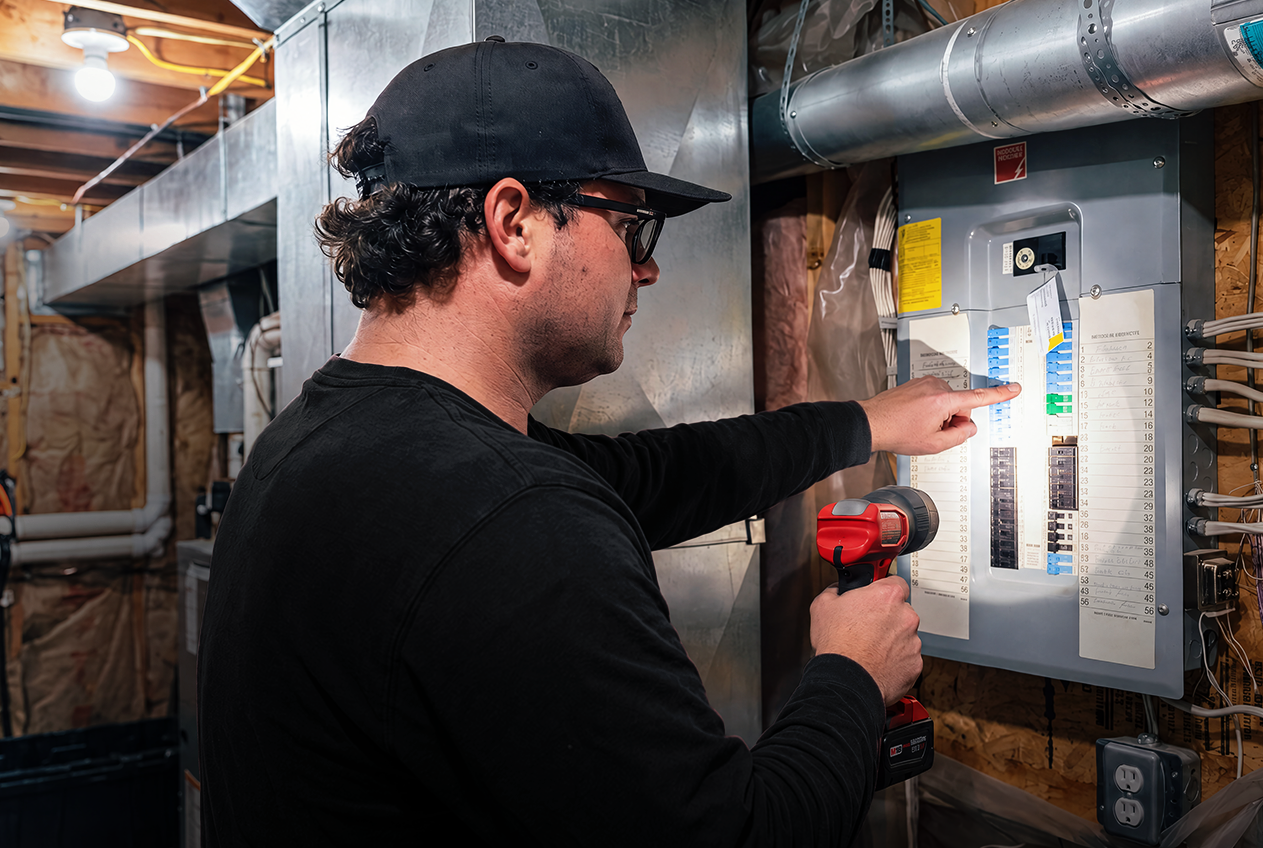
It’s a bitter -30°C January evening in Calgary.
Your furnace blower is roaring nonstop, the clothes dryer is tumbling the damp winter coats and ski pants, a space heater is keeping the basement warm where the kids are gaming, and dinner is bubbling in the oven.
Your partner pulls into the garage, plugs the car into your newly-installed Level 2 EV charger, and…click.
The house goes pitch black and totally silent. You’ve just encountered electrical panel limits for EV chargers at the worst possible time.

What the heck?
Level 2 Chargers Pull a LOT of Power
A lot of people think charging their electric vehicle (EV) at home is basically like plugging in the toaster. However, unlike that toaster, the EV will be the biggest power hog in the house, and if your electrical panel isn’t up to the task, it can cause serious issues.
If you get a Level 2 EV charger installed without considering your electrical panel’s limits, you’re getting into some risky territory for your budget, your lifestyle and even the safety of your home.
What are the Electrical Panel Limits for EV chargers?
An electrical panel’s limit is the maximum current (measured in amperes) your home can safely draw at any given moment before the main breaker trips.
In older, established neighbourhoods (think historic Altadore or Elbow Park), the homes often feature a 100-amp main service panel.
Developments built during the last 10-15 years are typically built standard with 200-amp panels.
In either case, adding a high-powered EV charger will require some adjustments due to a few factors:
- The 80% rule:
According to the Canadian Electrical Code (CEC), continuous loads—such as devices operating for over three hours straight, including EV chargers—must remain below 80% of the circuit breaker’s capacity, regardless of the breaker’s size.
- Heavy electricity draw:
A typical Level 2 EV charger draws between 30 and 48 amps continuously when connected to a dedicated circuit rated at 40 to 60 amps.
- The breakdown:
A 40-amp EV charger on a 100-amp electrical panel consumes almost half of your home’s main power capacity.
Practically speaking, when a Level 2 charger is charging an EV while a stove, clothes dryer, or hot tub is in use, your household’s total demand can surge past the electrical panel’s safe limits.
What Happens When You Overload Your Electrical Panel?
An overloaded panel can start a domino effect across your system.
1. Breaker trips
Circuit breakers will shut off power when too much current is drawn, to prevent overheating. If your main breaker trips each time you plug in your car while the oven is on or you’re drying clothes, it means there’s too much demand on your system.
2. Heat damage
Breakers can handle brief power spikes, but when a panel operates at near- or full capacity for hours on end, it will generate significant heat. Over time, the persistent heat will start to break down insulation, oxidize the copper and can also weaken breakers – all of which can lead to potential early component failure.
3. Fire risk
In an older home with outdated panels or loose wiring connections that handle sustained overloads, there is a high likelihood of electrical arcing. Electrical arcing is a definite fire risk.
4. Brownouts and worn-out appliances
Before a breaker trips, the overloaded panel can sometimes cause a voltage drop, leading to a ‘brownout’.
- Incandescent bulbs may appear dim or brownish, while LEDs may flicker or fail to turn on.

- Ceiling fans slow, or microwaves take longer to heat food.
- Refrigerators make a buzzing or straining sound instead of running smoothly.
- Computers, routers, or TVs restart on their own or drop internet connections.
When this happens repeatedly, the strain can shorten your appliance’s lifespan.
A Note on Winter
When temperatures drop to -30°C, household energy usage will definitely increase.

An electrical system that is easily tripped during a mild fall will struggle to keep even basic electrical functions running when severe cold hits.
It goes without saying that mid-January isn’t the time you want your heat to shut off repeatedly.
The Next Best Steps
The good news is that even if your panel is close to its maximum capacity, you don’t have to give up fast overnight charging with a Level 2 EV charger.
- Step 1: Get a professional load calculation:
We’ll get an accurate record of how much power your house uses in a year and run an official load calculation to see exactly what your current panel can handle, all while keeping up to code.
- Step 2: Choose the solution that fits your budget
Option A:
If a service upgrade is outside your budget, a load-sharing device known as an energy management system (EVEMS) monitors your home’s power and pauses the Level 2 EV charge when large appliances (like dryers or ovens) turn on, then resumes when demand drops.
Option B: Consider a total panel upgrade:
Upgrading from 100-amp to 200-amp service isn’t the cheapest, but it ensures ample capacity and future-proofs your home’s electrical needs.
Key Takeaways for EV Owners Wanting a Level 2 Charger
Get your current panel checked: A Level 2 charger drawing up to 50% of a 100-amp panel can cause future electrical problems if not checked and addressed.
Watch for panel stress: If you experience tripping breakers, hot panel doors, or dimming lights, your system is likely overloaded and requires caution before installing a charger.
Plan for winter: Winter increases home heating and EV charging times, so summer installations need to account for upcoming seasonal demands.
Explore alternatives: If your panel can’t handle a Level 2 charger with its current capabilities, ask Zeus about an EVEMS. It manages power automatically, allowing for fast charging without needing a full service upgrade.
Trust Zeus to Help
Work with certified experts like Zeus to safely install your Level 2 EV charger.
We’re local, code-compliant, and dedicated to keeping you fully charged. Contact us today for a safe, worry-free installation.